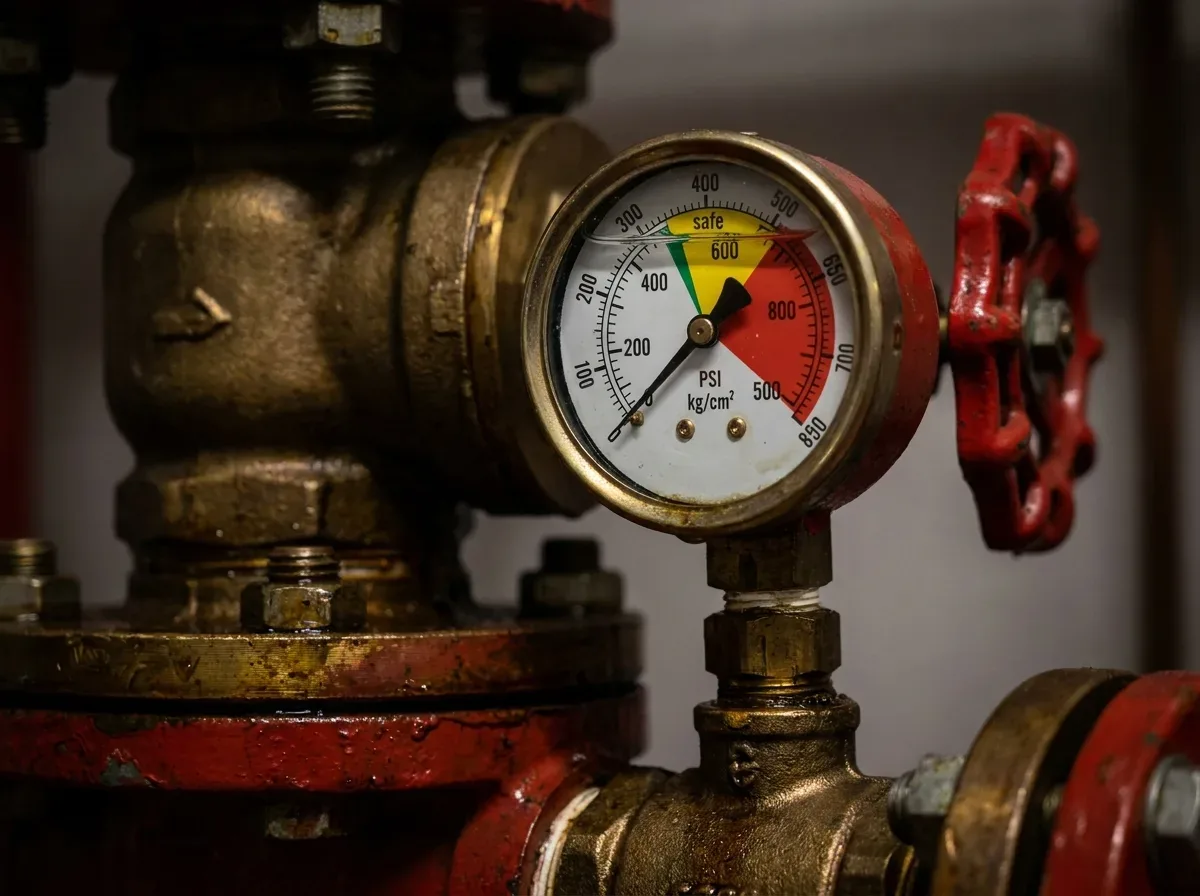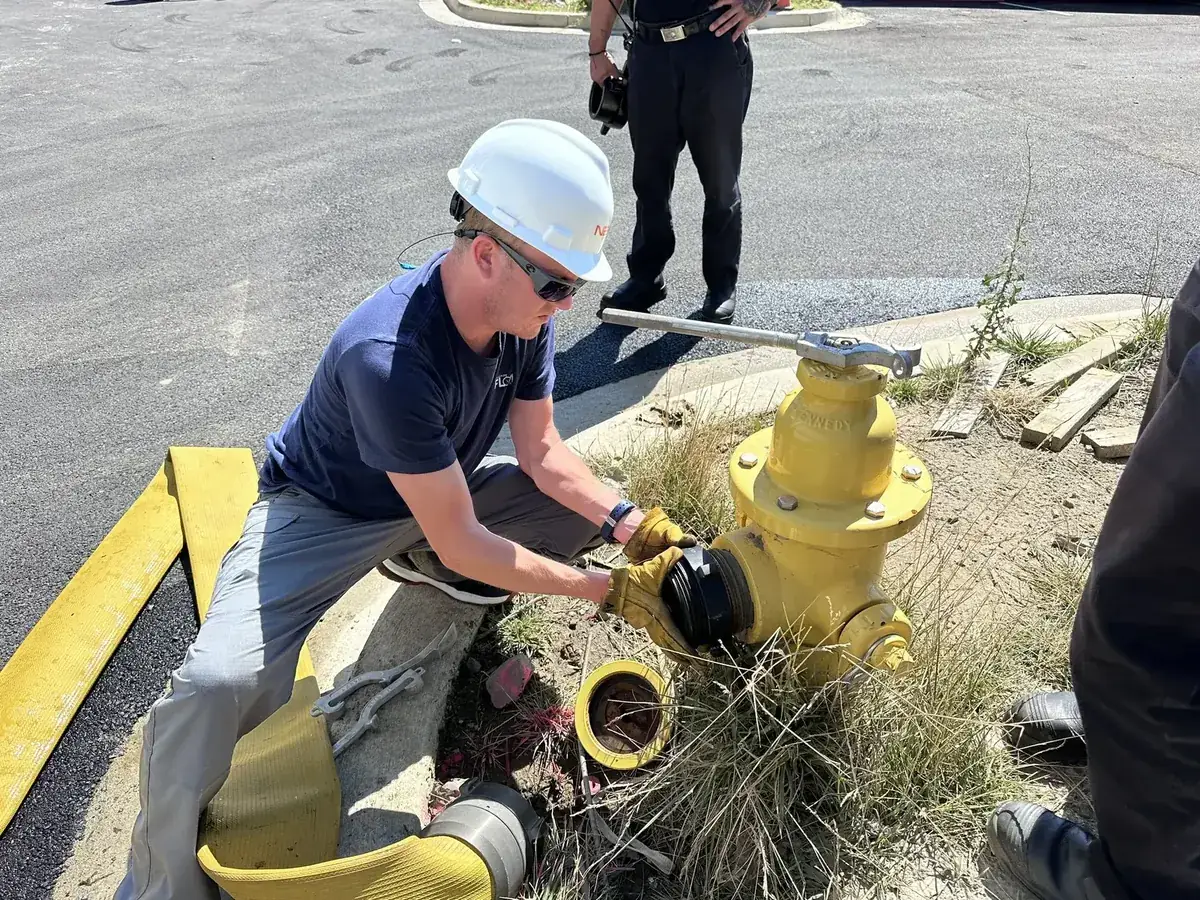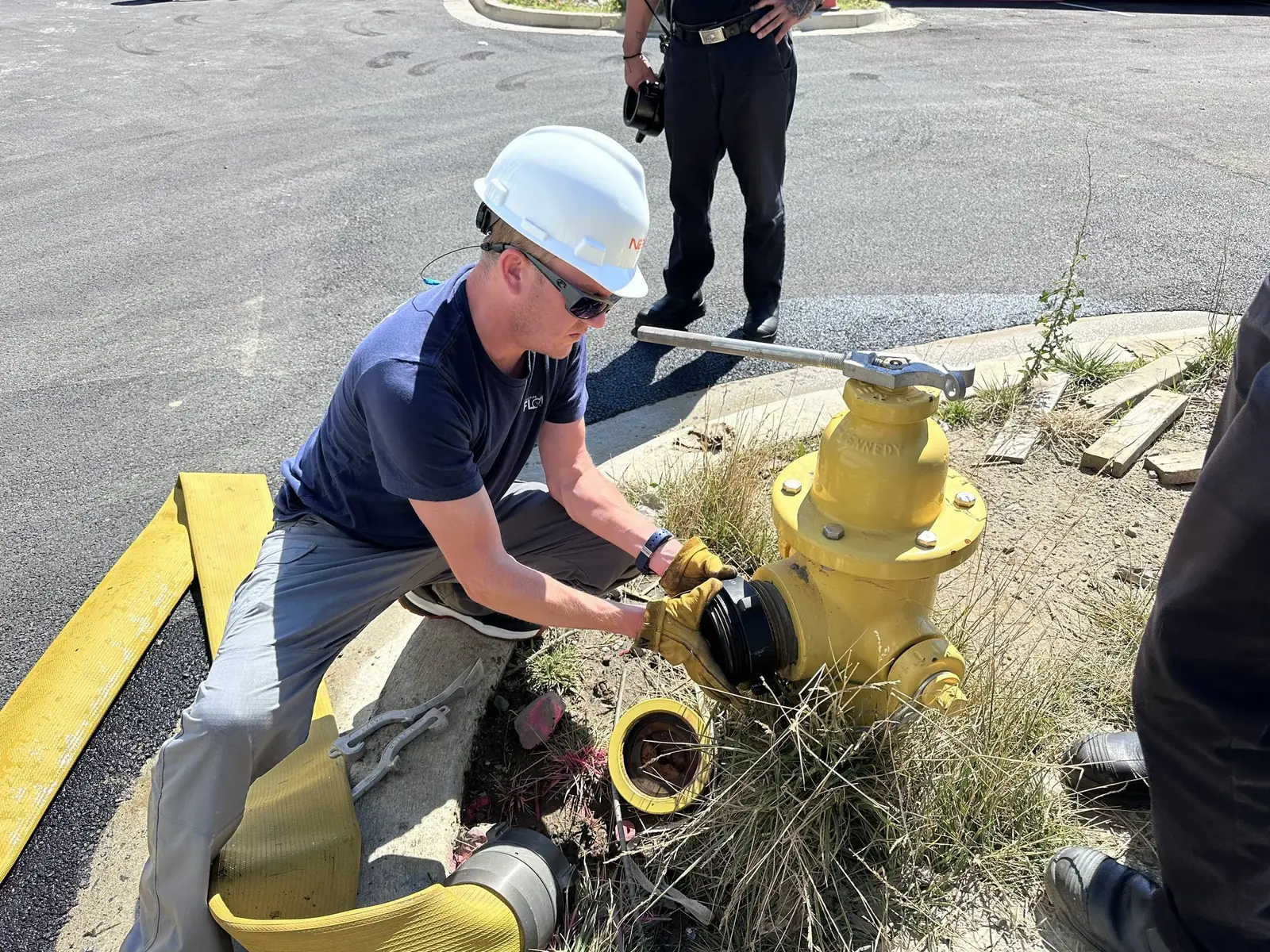

A hydrant flow test gives three core numbers: static pressure, residual pressure, and measured flow. Our hydrant flow test calculator turns a pitot reading into gallons per minute. A usable field test also records static and residual at a test hydrant, the hydrants and conditions, and a written report someone else can use.
FLOW performs that water-side test across Virginia, Maryland, Washington DC, North Carolina and South Carolina. FLOW does not work on sprinkler systems.
What static, residual and flow mean
These three readings describe what the municipal supply delivered at a given location, at the time of the test:
- Static pressure: the pressure in the main with no flow.
- Residual pressure: the pressure at a test hydrant while water flows from one or more flow hydrants.
- Flow: the measured gallons per minute at the flow hydrant or hydrants, at that residual pressure. Flow is usually found by reading pitot (velocity) pressure in the discharging stream, then converting that reading with the outlet diameter and a discharge coefficient that matches the outlet shape.
Static by itself is not a flow rate. Pitot pressure by itself is not a flow rate either. The three numbers together are what let a designer understand the supply at that location.
What the calculator does, and what a field test adds
The calculator does the arithmetic once you already have a pitot reading, an outlet size, and a coefficient. It does not replace flowing a hydrant, reading residual at a separate test hydrant, coordinating with the water utility, or writing down the hydrants, date, time and conditions.
A field test typically uses two hydrants: one to flow water and one to read static and residual while that water is moving. Many utilities have their own process for permission, notification or witnessing a hydrant flow. Coordinate with the utility early.
When the test is done, you should have:
- Static and residual pressures at the test hydrant
- Measured flow at the flow hydrant or hydrants
- Hydrant locations
- Date, time and test conditions
FLOW records those items so a designer knows where the numbers came from. See fire hydrant flow tests for how we run the field work.
Available fire flow, in plain language
Designers use the three points to understand the supply at that location. From those points they can also project how much flow the supply would deliver at a different residual pressure. That projected figure is often called available fire flow. A common reference residual for that projection is 20 psi, but the method and the residual your project uses are decisions for the designer and the Authority Having Jurisdiction (AHJ).
Hydrant flow testing is commonly described in NFPA 291. Confirm the method with your designer, and confirm the adopted edition with your AHJ. Editions vary by jurisdiction and change over time. This article does not reprint formulas or tables from the standard.
Supply data reflects conditions at the time of the test. Municipal systems change as development, main work and pressure-zone adjustments happen. Ask your AHJ or the utility how recent the data should be for a submittal. For more on freshness, see Hydrant Flow Test Data Is Perishable.
Who uses the numbers
Designers use static, residual and flow to understand the available water supply for hydraulic calculations. Contractors and developers use current data so a design is not built on outdated numbers. Owners use the report as a record of what the supply delivered that day. AHJs may ask to see how recent the data is and how it was gathered.
FLOW does not design, install, inspect, test or repair sprinkler systems. That scope stays with the sprinkler contractor or engineer. We support that work on the water side: hydrant flow tests, standpipe flow and hydrostatic tests, fire pump flow tests, in-service ROV tank inspections with the tank kept full, and bulk water for pool fills. For the contractor overview, see Water-Side Testing and Data for Sprinkler and Fire-Protection Contractors.
When the calculator is enough, and when to book a field test
Use the calculator when you already have field readings and want to check the gallons-per-minute arithmetic, or when you are exploring how a pitot reading converts to flow.
Book a field test when you need current measured data, utility coordination, and a written report for a designer, an AHJ or a project file. The calculator cannot produce those readings or that report on its own.
How to schedule a hydrant flow test
When you reach out, send:
- Project location and that you need a hydrant flow test
- The hydrants or area of interest, if your designer has a preference
- Any utility or AHJ rules you already know about, such as witnessing or notification
- Site contact, access details and your preferred dates
What you get back: static, residual and flow values, hydrant locations, and test conditions, ready for your designer.
We work across Virginia, Maryland, Washington DC, North Carolina and South Carolina from our base in Richmond, VA.
FAQs
What do static, residual and flow mean on a hydrant flow test?
Static is the pressure in the main with no flow. Residual is the pressure at the test hydrant while water is flowing. Flow is the measured gallons per minute at the flow hydrant or hydrants at that residual pressure.
Does the hydrant flow test calculator replace a field test?
No. The calculator does the arithmetic once you have a pitot reading, an outlet size and a coefficient. A field test still means flowing the hydrant, reading static and residual, and recording the hydrants, date, time and conditions.
Can I use FLOW's flow test data in hydraulic calculations?
Our hydrant flow test data is gathered for use in design and hydraulic calculations. Your designer and the AHJ decide how the data is applied and how recent it should be for your submittal.
Does FLOW design or test sprinkler systems?
No. FLOW does not work on sprinkler systems. We support sprinkler and fire-protection contractors with water-side services: hydrant flow tests, standpipe flow and hydrostatic tests, fire pump flow tests, in-service tank ROV inspections and bulk water for pool fills.
How do I schedule a hydrant flow test?
Request a quote online or text 804-426-1226 with the project location, the hydrants or area of interest, and your preferred dates.
Get current hydrant data for your next job
Need a documented hydrant flow test, or help turning field readings into a report your designer can use? Request a quote, or text 804-426-1226. Texts only, please.