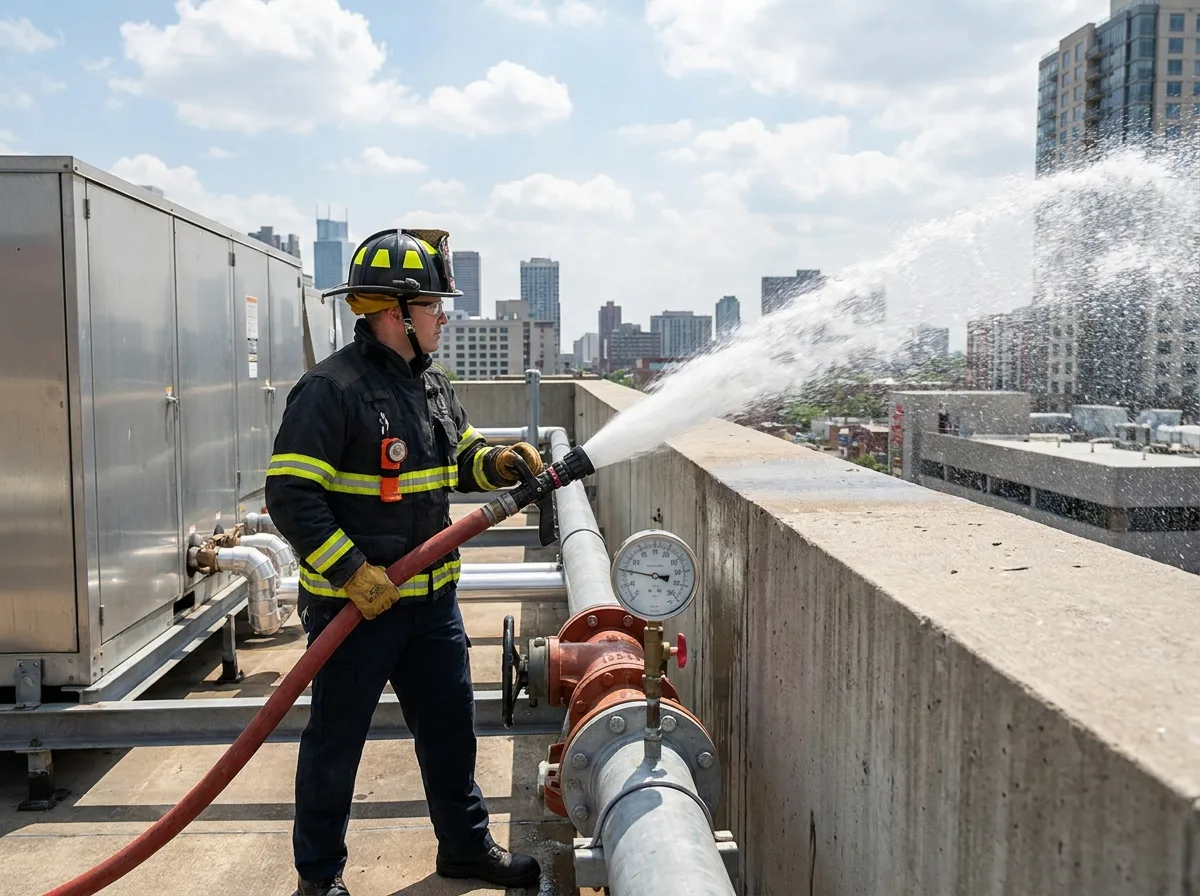
Maryland combines a dense high-rise corridor with some of the most active local fire prevention offices in the region. That makes the 5-year standpipe flow test a routine ask here rather than an occasional surprise. Here is what the state requires, where counties diverge, and how we cover it. The Q&A version is in the Maryland Fire System Testing FAQ.
The statewide baseline
The Maryland Building Performance Standards adopt the IBC, and the state adopts the IFC, both with amendments. Standpipes are installed to NFPA 14 and maintained under NFPA 25, which means the 5-year full-flow test, hydrostatic testing on dry and semi-automatic standpipes, and 3-year trip tests on dry pipe valves. See the NFPA 25 frequency chart for the whole interval map.
Counties amend upward
The statewide code is a floor. Montgomery County, Baltimore City, Baltimore County, Prince George's County, and Howard County each layer on their own inspection, reporting, and licensing expectations. We confirm the specific local requirement before mobilizing so the report satisfies your actual AHJ, not a generic template.
In Maryland the question is never just "what does the code say", it is "what does this county ask for on top of it."
Where we work
- Baltimore Metro: Baltimore City, Towson, Hunt Valley, Owings Mills.
- Montgomery County: Bethesda, Chevy Chase, Rockville, Gaithersburg, Silver Spring.
- Prince George's County: College Park, Hyattsville, National Harbor, Oxon Hill.
- Anne Arundel & Howard: Annapolis, Columbia, Ellicott City, BWI corridor.
- Frederick County and the Eastern Shore, including Salisbury and Ocean City.
Full list on the Maryland service area page.
Manual and dry standpipes in older stock
Baltimore has a large inventory of older buildings and historic conversions, and a lot of them carry manual wet or dry standpipes that require pumping into the FDC to test. That is standard work for us, we bring the truck. Background on system classes is in Class I, II, and III Standpipe Systems Explained.
One trip, three jurisdictions
Maryland, Washington DC, and Northern Virginia sit inside a single drive radius. If your portfolio spans the DMV, testing it on one mobilization cuts travel cost and puts every building on the same interval clock, the approach we describe in Multi-State Fire Protection Testing. See also the Virginia and DC guides.
What you receive
A signed report with measured static and residual pressures, flow rates, outlet locations, equipment used, and a pass/fail comparison against code or design criteria. That document is what your inspector, your engineer, and eventually your insurance adjuster will ask for. Property owners and managers get it filed in one place per building.
Request a quote with your Maryland site list and we will scope it as one project.